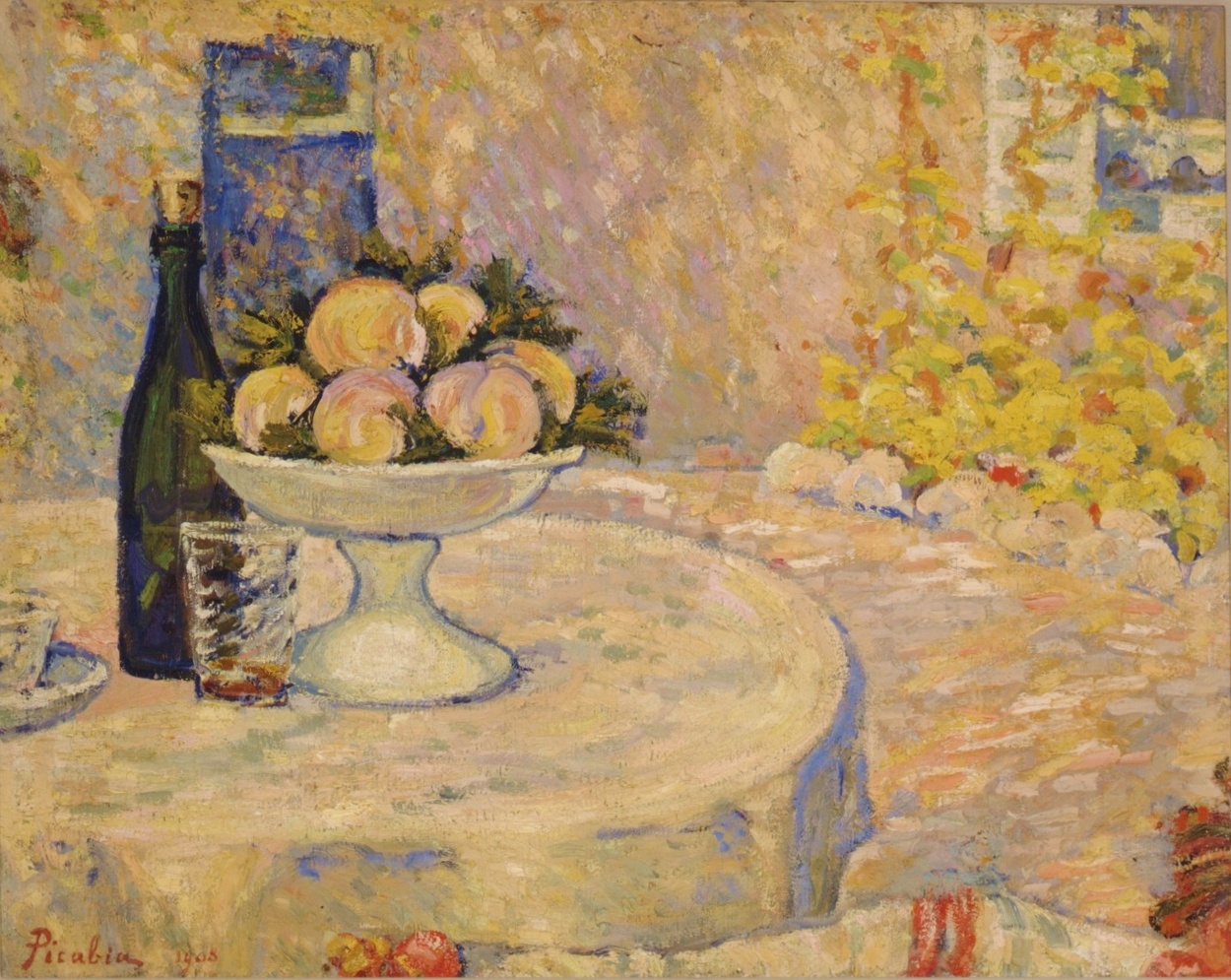
Still life in the Garden
Signed and dated lower right: Picabia 1908
Provenance:
Galerie Spiess, Paris
Private Collection, Canada
Acquired by the previous owner in Paris in the 1980s
The authenticity of this work has been confirmed by the Comité Picabia.
The present work demonstrates an interesting and phase of transition in Picabia’s production. The year 1908 represents the full realization of Picabia’s neo-impressionist mode and the subsequent integration of fauvist and cubist methods. Still life in the garden is an example of his neo-impressionism at its most pure phase: forms are expressed with lively, wet brushwork, thick impasto, and vibrant color. In the foreground a porcelain dish filled with fresh peaches sits upon a tabletop. An empty wine bottle and a short glass with a residue of red wine sit next to it, and a tea cup is placed at the edge of the table, only half-visible within the confines of the composition. Brilliant sunlight fills the scene, which is set in a courtyard as is evident from a shaded, blue doorway at left and the colorful vines climbing up a windowsill at right. The image is painted in thick swirls of yellow, orange and sky blue that add to the impression of a shimmering summer afternoon.
While Francis Picabia is commonly associated with Dadaism and the Puteaux Group, his first great successes came from works completed in an Impressionist manner. Beginning in 1902-1903, the young Picabia painted Impressionist landscapes at Moret-sur-Loing, a site that had been an inspiration for Monet, Renoir and Sisley, as well as at the Martigues. Highly influenced by these artists, and Sisley in particular, Picabia completed series of works depicting the same site under different conditions of weather, seasons and at different times of the day. He mastered an Impressionist technique and exhibited his works regularly at the Salon des Artistes Français (the famous annual Paris Salon), as well as the progressive Salon des Indépendants (which was founded in 1884 by a group that included Cezanne, Gauguin, and Pissarro) and the Salon d?Automne. Great success came in 1904, when Picabia landed a one-man exhibition at the prestigious Galerie Haussmann. The exhibition opened in February 1905 with 61 works and accompanied by a catalogue and biography of the artist written by the prominent writer, Léon Roger-Milès. Roger-Milès commended Picabia for understanding the long effort it took Sisley and Pissarro to conquer light, and for his courage to resist temptations that led other adherents of Impressionism to offer mere exercises in virtuosity. (1) He wrote, ?We wander through his landscapes?. He renders them with a joy in color that delights you? what he?s really trying to do, is to express?the music inherent in the things he hears in his soul.? The critical response to the exhibition was overwhelmingly positive, and largely echoed Roger-Milès sentiment that Picabia?s Impressionist work was personal and unique, far from being derivative of the work of the Impressionist masters. Art critic Louis Vauxcelles acknowledged that ?there may be suggestions in him of similarities with Pissarro, and especially with Sisley,? but while so many dishonest followers plagiarize Monet, Sisley, and Pissarro, and steal their effects, M. Picabia, who already possesses a very individual technique, expresses, year after year, a temperament that is his own, and his alone.? (2) Sales from the exhibition included the first of Picabia?s paintings to be acquired by the State.
Over the next two years, Picabia continued to refine his Impressionist work, travelling to paint at Ouistreham, Passy-les-Tours, Nemours, Montigny, and the Martigues, as well as continuing to paint at Moret and Villneuve-sur-Yonne. He continued to send large, salon-style Impressionist paintings to the Salon of the Artistes-Français, as well as sending works to exhibitions in Nancy, Bayonne-Biarritz and to another solo show in Berlin in 1906. Galerie Haussmann held another one-man exhibition in 1907, again with a catalogue and text by Roger-Milès who described Picabia as a ?virtuoso, seated at his keyboard, plucking scales.? Picabia?s admiration of Sisley is evident in the work of this time (and indeed the artist even helped to raise financial support for a monument to Sisley at Moret). Yet while comparisons to the work of Sisley continued, Picabia confirmed the personal character of his work when he commented that ?craft in any fashion must not be the quest of the painter; he must reproduce the emotion which nature made him feel without the least care for technique.? (3) Following this second successful exhibition at Galerie Haussmann, Picabia participated in group exhibitions in Barcelona and Munich and had a solo show at the Cremetti Gallery in London that elicited another critical comparison to the original Impressionists.
Picabia continued his Impressionist mode until late in 1908. In a short few months, he shifted his focus to a form of Neo-Impressionism based on the work of Signac, abandoning his Impressionist style. In March of 1909, Picabia?s dealer Danthon cleared his gallery of Picabia?s Impressionist work, auctioning ninety-nine paintings, drawings and prints at the Hôtel Drouot. From this time, elements of Fauvism and Neo-Impressionism as well as Cubism and other forms of abstraction appeared in his painting, and by 1912 he had evolved a personal amalgam of Cubism and Fauvism. Picabia worked in an abstract mode from this period until the early 1920s.
Picabia became a friend of Guillaume Apollinaire and Marcel Duchamp and associated with the Puteaux group in 1911 and 1912. The Puteaux group was an offshoot of Cubism who held an interest in Euclidean theories on proportion and advocated a mélange of modern tendencies, in particular combining cubism with the color of fauvism and the lyrical subjects of post-impressionism. Picabia participated in the 1913 Armory Show, visiting New York on this occasion and frequenting avant-garde circles. Alfred Stieglitz gave him a solo exhibition at his gallery ?291? that same year. In 1915, which marked the beginning of Picabia?s machinist or mechanomorphic period, he and Duchamp, among others, instigated and participated in Dada manifestations in New York. Picabia lived in Barcelona in 1916 and 1917. In 1917, he published his first volume of poetry and the first issues of 391, his magazine modeled after Stieglitz?s periodical 291. For the next few years, Picabia remained involved with the Dadaists in Zurich and Paris, creating scandals at the Salon d?Automne, but finally denounced Dada in 1921 for no longer being ?new.? The following year, he moved to Tremblay-sur-Mauldre outside Paris, and returned to figurative art. In 1924, he attacked André Breton and the Surrealists in 391.
Picabia moved to Mougins in 1925. During the 1930s, he became a close friend of Gertrude Stein. By the end of World War II, Picabia returned to Paris. He resumed painting in an abstract style and writing poetry. In March 1949, a retrospective of his work was held at the Galerie René Drouin in Paris. Picabia died November 30, 1953, in Paris.
(1) William Camfield, Beverly Calté, Candace Clements, Arnauld Pierre, Francis Picabia, Catalogue Raisonné, Vol. 1 (Yale University Press, New Haven and London, 2014): p. 46
(2) ibid., p. 48.
(3) Ibid, p. 52.
Selected Museum Collections:
Antibes, Musée Picasso; Beauvais, Musée départemental de l?Oise; Brussels, Musée d?Art Moderne; Chicago, Art Institute; Henau, Switzerland, Hauser and Wirth Collection; Lille, Musée des Beaux-Arts; Lisieux, Musée d?Art et d?Histoire; London, Royal Academy of Arts; London, Tate Gallery; Marseille, Musée Cantini; Minneapolis, Walker Art Center; New York, Guggenheim Museum; New York, Metropolitan Museum; New York, Museum of Modern Art; Ottawa, National Gallery of Canada; Paris, Musée d?Orsay; Paris, Musée National d?Art Moderne, Centre Georges Pompidou; Paris, Musée d?Art Moderne de la Ville de Paris; Philadelphia, Museum of Art; San Francisco, Fine Arts Museums; Strasbourg, Musée des Beaux-Arts; Tournus, Musée Greuze; Turin, Galleria Civica d?Arte Moderna e Contemporanea; Venice, Peggy Guggenheim Collection; Vienna, Museum Moderner Kunst Stiftung Ludwig Wien; Washington D.C, National Gallery of Art;
Request more information
News on the artist
-
NYTimes tour of @the_barnes Foundation's now closed collection of #Impressionist, #PostImpressionist & #Fauvist art. http://t.co/vlPeQhkJuly 28, 2011 @ 2:36 PM UTC
-
The battle continues: PA Judge Hears Arguments Over Moving of the @the_Barnes: http://t.co/mSUXpx6 via @AddThis #PostImpressionist #FauveAugust 2, 2011 @ 2:21 PM UTC
-
Previously unknown Klimt painting discovered in Netherlands collection: http://t.co/gM4kOKD #PostImpressionistSeptember 8, 2011 @ 3:46 PM UTC
-
Grand jury indicts woman for attacking paintings @ngadc http://t.co/YyZ6K2O via @washingtonpost #PostImpressionistSeptember 12, 2011 @ 5:06 PM UTC
-
Hemingway liked #Cabanel #Cezanne #Manet at the Met: http://t.co/IF0ljzf2 #Academic #PostImpressionistSeptember 16, 2011 @ 3:28 PM UTC
-
Modern Masters from the Stein Collection moves to Grande Palais, then the Met in Feb! http://t.co/KK3fsxap #Impressionism #PostImpressionistOctober 5, 2011 @ 5:21 PM UTC
-
New art history controversy begins: New book questions if #VanGogh really killed himself: http://t.co/P37oJSAC #PostImpressionistOctober 14, 2011 @ 3:12 PM UTC
-
Cross and Neo-Impressionism: From Seurat to Matisse at the Marmottan, Paris: http://t.co/1N02ywav #PostImpressionist #DivisionistOctober 17, 2011 @ 3:41 PM UTC
-
National Gallery of Art to reopen 19th-century French galleries in January: http://t.co/2HcCfSuF #Academic #PostImpressionist #BarbizonOctober 20, 2011 @ 9:17 PM UTC
-
#VanGogh Museum Says "Not Enough Evidence" That Artist's Death Was Anything But Suicide -ARTINFO.com http://t.co/hQZUmflw #PostImpressionistOctober 24, 2011 @ 7:40 PM UTC
-
Vincent #VanGogh and Paul #Gauguin's Journey on view at the Palazzo Ducale in Genoa: http://t.co/JOHj62X1 via @AddThis #PostImpressionistNovember 16, 2011 @ 3:55 PM UTC
-
#Monet, #Renoir and Cézanne return @FitzMuseum_UK as famous artworks go on display: http://t.co/676HHuQx #PostImpressionist #ImpressionismJanuary 3, 2012 @ 5:20 PM UTC
-
Happy Birthday Paul Cezanne, 1839!! http://t.co/tMqzOqdc #PostImpressionistJanuary 19, 2012 @ 3:49 PM UTC
-
January 25, 2012 @ 5:57 PM UTC
-
Fondation Beyeler offers a fresh review of Pierre #Bonnard's entire career: http://t.co/P9hjN4v1 #Nabis #PostImpressionist #exhibitionsJanuary 31, 2012 @ 4:55 PM UTC
-
Would love to page through this Book #Delacroix #Boudin #Degas #Cross #Guillaumin #Marquet http://t.co/qgTKbm7j #Academic #PostImpressionistFebruary 1, 2012 @ 4:33 PM UTC
-
#Pointillist painting by van #Rysselberghe enters the Portland Art Museum's collection: http://t.co/DPvBsMpt #PostImpressionist #museumsFebruary 2, 2012 @ 4:52 PM UTC
-
Only 3 weeks left to see #Cezanne and Paris @museeluxembourg http://t.co/vRLTusTe #PostImpressionist #ExhibitionsIwishIcouldseeFebruary 6, 2012 @ 4:23 PM UTC
-
#PostImpressionist masters and their handheld cameras @PhillipsMuseum: http://t.co/VVnYuWH8 #Nabis #Vuillard #Denis #Bonnard #exhibitionsFebruary 6, 2012 @ 4:56 PM UTC
-
Over 150,000 tickets booked for #VanGogh Up Close @philamuseum: http://t.co/4sr7aF2M #museums #PostImpressionist #exhibitionsMarch 30, 2012 @ 8:29 PM UTC
-
Paradises & Landscapes in the Thyssen Coll. opens in Málaga: http://t.co/bS54sQ4n #Barbizon #PostImpressionist #Impressionism #exhibitionsApril 10, 2012 @ 3:09 PM UTC
-
#Cezanne masterpiece believed recovered by Serbian police: http://t.co/ahZBm7oA #PostImpressionistApril 12, 2012 @ 7:43 PM UTC
-
Snapshot: Painters and Photography, #Bonnard to #Vuillard @PhillipsMuseum through May 6 http://t.co/xIY3M5wE #PostImpressionist #NabisApril 27, 2012 @ 4:17 PM UTC
-
The Jewish Museum NY | Edouard #Vuillard: A Painter and His Muses 1890-1940 http://t.co/W3eD536S #PostImpressionist #Nabis #exhibitionsMay 4, 2012 @ 7:18 PM UTC
-
@the_barnes reopens in its new Philadelphia home. Read the NYTimes review & slideshow http://t.co/9DwA0ibG #Impressionism #PostImpressionistMay 21, 2012 @ 5:53 PM UTC
-
And Happy belated #birthday to André #Derain, June 10, 1880. http://t.co/vrCweCbT #PostImpressionistJune 11, 2012 @ 8:48 PM UTC
-
Here's a preview of Becoming #VanGogh at the Denver Art Museum (PHOTOS) http://t.co/qy2s3TFS @HuffPostArts #exhibitions #PostImpressionistJune 26, 2012 @ 10:31 PM UTC
-
August 6, 2012 @ 4:46 PM UTC
-
August 8, 2012 @ 8:26 PM UTC
-
Van Gogh Museum receives millionth visitor http://t.co/iBHSsf8j @vangoghmuseum #museums #PostImpressionistAugust 16, 2012 @ 3:14 PM UTC
-
Heir demands #Signac painting be saved from spitballs - The Art Newspaper http://t.co/riA2hfub #Pointillism #PostImpressionistAugust 16, 2012 @ 3:17 PM UTC
-
September 26, 2012 @ 8:31 PM UTC
-
#VanGogh Museum Reopens with Revealing Exhibition http://t.co/yZ4veQThtA via @sharethis #ExhibitionsIwishIcouldsee #PostImpressionistMay 6, 2013 @ 3:11 PM UTC
-
The Morgan presents over 100 new acquisitions with works by #Manet, #Cézanne, #Vuillard, #Redon | http://t.co/xx5rKsa9oO #PostImpressionistJune 3, 2013 @ 10:05 PM UTC
-
August 8, 2013 @ 8:50 PM UTC
-
Happy Birthday Georges Seurat, born Dec 2, 1859! http://t.co/mm1HSRpJkN #divisionism #pointillism #PostImpressionistDecember 2, 2013 @ 4:57 PM UTC
-
#Getty Museum acquires significant early drawing by Impressionist Georges #Seurat http://t.co/rojq2UFQ6M #Divisionism #PostImpressionistFebruary 10, 2014 @ 8:07 PM UTC
-
#VanGogh Repetitions opens at the Cleveland Museum, March 2 http://t.co/jnk5TC7gTs #PostImpressionist #exhibitionsIwishIcouldseeFebruary 21, 2014 @ 10:40 PM UTC
-
July 10, 2014 @ 3:08 PM UTC
-
Indianapolis Museum of Art publishes survey of #NeoImpressionist portraiture http://t.co/xHWqGW7lE7 #divisionist #PostImpressionistAugust 13, 2014 @ 3:01 PM UTC
-
Take a look at our new catalogue of gallery acquisitions: https://t.co/1oOYwViYZK #Lhermitte #DiazdelaPena #Dore #Guillaumin #Loir #PicabiaJanuary 14, 2016 @ 5:52 PM UTC
-
February 19, 2016 @ 4:51 PM UTC
-
Take a look at our new catalogue of European masterworks: https://t.co/l6sb9ckudA #Bouguereau #Picabia #Corot #Millet #Lhermitte #MoretOctober 14, 2016 @ 8:39 PM UTC
-
Opening at MoMA: Francis #Picabia : Our Heads Are Round so Our Thoughts Can Change Direction: https://t.co/r6uH5U1KUi #exhibitionsNovember 17, 2016 @ 6:09 PM UTC
-
MoMA's first monographic exhibition of Francis #Picabia brings together some 200 works https://t.co/jqGfakxO8O #PostImpressionism #ModernismNovember 22, 2016 @ 9:30 PM UTC
-
A belated Happy Birthday to Francis #Picabia , Jan 22, 1878! https://t.co/XLM09QnKsc #artistbirthdays #Modernism #PostImpressionismJanuary 24, 2017 @ 3:58 PM UTC